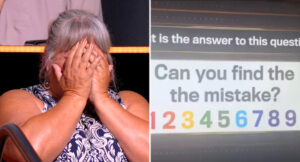
A contestant on The 1% Club was left hiding her face in embarrassment after overlooking a small but crucial mistake in what appeared to be a straightforward question. Despite several hints from host Lee Mack, Mo struggled to spot the error, which had nothing to do with the numbers in front of her.
For viewers watching at home, the answer was surprisingly simple. For Mo, however, it took three attempts and some gentle prompting before she finally realised what she had missed.
Can You Spot the Mistake?
Broadcast on ITV, The 1% Club puts contestants’ reasoning and logical thinking to the test. The show features an audience of 100 people who must work through a series of questions that become progressively more difficult, with fewer people expected to know the correct answer as the game advances.
Those who make it through to the final have the chance to win up to £100,000. Unlike traditional quiz shows that often rely on general knowledge, The 1% Club challenges players to think carefully, recognise patterns and look beyond the obvious.
That approach was put to the test when contestant Mo faced a question that seemed almost impossible to get wrong.
The challenge read:
“Can you find the the mistake? 1, 2, 3, 4, 5, 6, 7, 8, 9.”
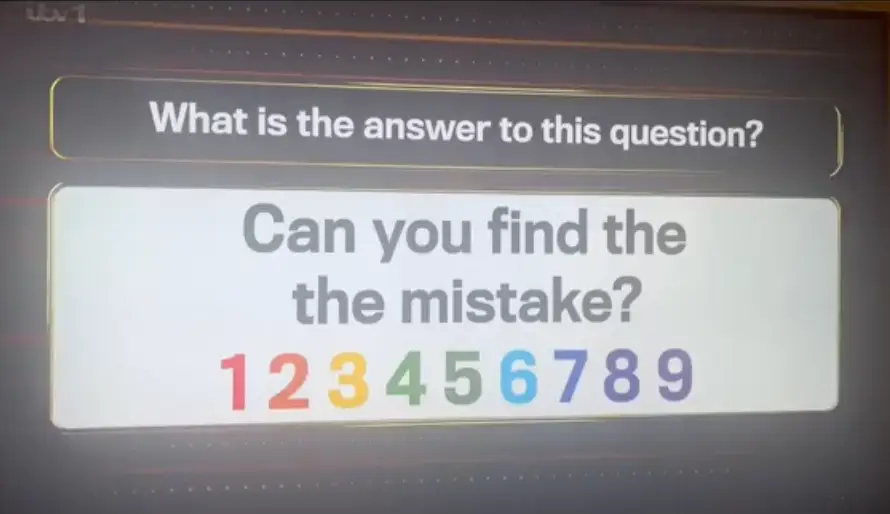
At first glance, the sequence of numbers appeared perfectly normal. They ran neatly from one to nine, with no obvious errors or missing digits.
But the numbers were never the point of the question.
The mistake was hidden in the wording itself: the word “the” appeared twice in the sentence asking contestants to find the error.
Lee Mack Tries to Give Mo a Helping Hand
While some viewers may have spotted the duplicated word almost immediately, Mo was completely stumped.
Mack addressed the contestants, asking whether anyone was struggling to work out the answer. He reassured them that they would not be ridiculed for admitting they were stuck, although he added with a touch of humour that they might receive a little teasing.
Mo was happy to admit that she had no idea what the mistake could be.

Trying to understand where she was going wrong, Mack asked her what the problem was and whether she simply could not think of an answer.
“Absolutely no idea,” she replied.
Rather than revealing the solution straight away, the host decided to give her another chance to work it out for herself. His suggestion was simple: read the question aloud.
Mo followed his advice, but there was one problem. As she read the sentence, she skipped over the second occurrence of the word “the”, completely missing the very detail she was supposed to identify.
Mack stopped her before she reached the sequence of numbers and encouraged her to try again. When that still did not work, he asked her to repeat the sentence once more, this time taking it more slowly.

The Answer Finally Clicks
Eventually, Mo realised what had been hiding in plain sight. The numbers were correct all along; the duplicated word at the beginning of the question was the only mistake.
The moment the answer dawned on her, she looked visibly embarrassed and covered her face with her hands. After struggling to spot such a small error, she could hardly believe she had overlooked it.
Her reaction made the moment all the more entertaining, particularly because Mack had given her several opportunities to find the solution herself.
The host acknowledged that she had eventually worked it out, but he was quick to point out that the extra time she needed could become a problem later in the game.

“The good news is, you got there in the end. The bad news is, that definitely took you more than thirty seconds, which is what the rules are for the end of the game and I won’t be able to help you like that on every one of them,” Mack told her.
His comment was a reminder that, although a little assistance was available during the exchange, contestants could not rely on the same level of help when the questions became more challenging.
Fortunately, Mo appeared to take the incident in good humour. Even as she continued to hide behind her hands, she could be seen laughing at her own mistake.
For a question that required little more than careful reading, it proved to be an amusing reminder of how easily a tiny detail can escape notice when people concentrate on the bigger picture. In this case, the sequence from one to nine was a distraction, while the real answer was sitting right at the beginning of the question.