Dolly Parton Turned The Pain Of 9/11 Into A Prayer — 25 Years Later, ‘Hello God’ Feels More Powerful Than Ever
Twenty-five years after the September 11 attacks, one of Dolly Parton’s most deeply personal songs still carries the weight of the tragedy that inspired it.
“Hello God” was not written as a conventional patriotic anthem. It was something far more vulnerable — a prayer from a woman trying to understand how so much suffering could exist, and asking where humanity could turn when the world suddenly seemed broken.
Parton wrote the song in the aftermath of September 11, 2001, when nearly 3,000 people were killed in attacks on the World Trade Center in New York City and the Pentagon in Arlington, Virginia, while another hijacked plane crashed near Shanksville, Pennsylvania.
The tragedy left millions searching for answers.
Parton did what she had always done.
She wrote.
September 11 Left Dolly Searching For Answers

In the period following the attacks, Parton found herself thinking deeply about faith, violence and the fragility of life.
According to comments preserved in the Dollymania archive, several songs came to her around that period, including “Color Me America,” “Raven Dove” and “Hello God.”
But “Hello God” approached the tragedy differently.
Instead of offering certainty, Parton allowed herself to wrestle with the questions that tragedy can force people to confront.
Why does God allow terrible things to happen?
Why do human beings continue hurting one another?
How can people claim to act in God’s name while committing acts of hatred and violence?
And where does humanity turn when its own strength is no longer enough?
For Parton, those questions eventually led back to prayer.
She Didn’t Pretend Faith Made The Questions Disappear
Parton had spoken openly throughout her life about her Christian faith.
Yet “Hello God” is powerful precisely because it does not present faith as something that automatically removes fear or doubt.
The song sounds like a conversation taking place during a crisis.
Parton addresses God directly while confronting a world that appears to have lost its way. She acknowledges human weakness and the destructive ways people can use their freedom.
There is frustration in the song.
There is fear.
There is confusion.
But underneath all of it is the belief that humanity still needs something greater than itself.
Parton explained that the events surrounding September 11 reminded her how quickly everything people take for granted can disappear.
Human beings may convince themselves they can handle everything alone.
Then something happens that exposes just how vulnerable they really are.
That realization became the emotional foundation of “Hello God.”
The Song Became A Plea Rather Than An Answer
Parton did not attempt to explain September 11 through the song.
Instead, she asked for help.
That distinction gives “Hello God” much of its lasting emotional force.
The song considers a world filled with sadness, hatred and violence while pleading for love and guidance.
It also confronts the idea of free will and the damage human beings can cause through their own choices.
Rather than speaking to listeners from a position of certainty, Parton places herself among them.
She is searching too.
That vulnerability allowed the song to move beyond the historical moment that inspired it.
September 11 was the catalyst, but grief, fear and the inability to understand suffering are universal.
Dolly Took The Prayer To The CMA Awards

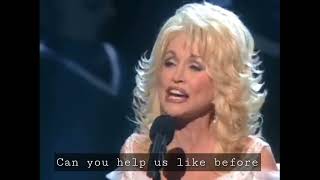
Parton gave “Hello God” one of its defining public moments at the 36th Annual Country Music Association Awards in Nashville on November 6, 2002.
Joined by The Christ Church Choir of Nashville, she delivered a performance that felt less like a traditional awards-show number and more like a public prayer.
The performance was subsequently used as the song’s music video.
“Hello God” was released as the third single from Parton’s Halos & Horns album on November 11, 2002.
The album itself had arrived earlier that year, on July 9.
It was Parton’s 39th solo studio album and completed the acclaimed bluegrass trilogy that also included The Grass Is Blue and Little Sparrow.
Halos & Horns later received a Grammy nomination for Best Country Album, while “Dagger Through the Heart” and “I’m Gone” earned Best Female Country Vocal Performance nominations in successive years.
“Hello God” reached No. 60 on Billboard’s Hot Country Songs chart and won Single of the Year at the International Country Gospel Music Association Awards in 2003.
But its chart position never fully captured the song’s significance.
‘Hello God’ Stayed With Her
Parton continued returning to the song long after its original release.
More than a decade later, she chose “Hello God” to close every performance of her 2016 Pure & Simple tour.
That decision demonstrated how deeply the song remained connected to her.
Parton had an enormous catalogue to choose from.
She could finish a concert with one of the universally recognized hits that had made her famous.
Instead, night after night, she ended by returning to this prayer.
For audiences, it offered another side of an artist often associated with humor, optimism and an instantly recognizable larger-than-life personality.
Behind all of that was a songwriter capable of putting fear and spiritual uncertainty into remarkably simple words.
The Message Outgrew The Moment That Inspired It
“Hello God” was born from the aftermath of September 11, but it was never confined to September 11.
That is one reason the song has endured.
Its central emotions can emerge after any tragedy.
There are moments when life changes without warning, when people feel powerless and when familiar explanations suddenly seem inadequate.
Parton understood that experience.
Her response was not to pretend she possessed all the answers.
It was to keep asking.
And ultimately, it was to ask for love.
That makes “Hello God” fundamentally different from many songs written in response to national tragedy.
Its message is not about revenge.
It is not about anger.
It is about recognizing human weakness and asking whether compassion, faith and love can still offer a way forward.
The Song Carries Even More Weight After Dolly’s Death
Following Parton’s death on August 25, 2026, at the age of 80, songs from across her extraordinary career have inevitably taken on new emotional meaning.
“Hello God” is among those that now hit differently.
For decades, listeners knew they were hearing Dolly sing a prayer inspired by one of America’s darkest days.
Now there is another layer.
The voice delivering that prayer belongs to an artist who is no longer here.
That reality makes revisiting the performance especially poignant.
Her delivery never needed theatrical excess. The emotion came from the simplicity of the message and the unmistakable sincerity in her voice.
Twenty-five years after September 11, hearing her sing it again can feel less like revisiting an old recording and more like hearing a message preserved from another time.
Her Voice Turns The Song Into Something Timeless
There are Dolly Parton songs that immediately bring joy.
There are songs that tell unforgettable stories.
There are songs about heartbreak, ambition, love and leaving.
“Hello God” occupies another space entirely.
It captures Parton asking the same questions millions of people were asking after September 11 — and admitting that sometimes the only thing left to do is pray.
Her voice gives the song a tenderness that keeps it from becoming overwhelmed by the enormity of its subject.
That is why the recording still feels so moving.
Parton was not singing as an icon trying to deliver a grand statement.
She sounded like a human being looking upward and asking for help.
Twenty-Five Years Later, The Prayer Remains
A quarter-century has now passed since the attacks that inspired “Hello God.”
The world has changed enormously.
The emotions inside the song have not.
People still experience moments when circumstances change without warning.
They still struggle to understand violence and suffering.
They still search for something to hold onto when answers do not come.
And that is why “Hello God” continues to resonate.
The studio recording remains perhaps the purest expression of Parton’s original idea: a direct and vulnerable conversation with God from someone confronting human weakness and searching for hope.
Written and produced by Parton, the track appeared as the fourth song on Halos & Horns.
But its importance was never about where it appeared on an album or how high it climbed on a chart.
It was about what Dolly Parton managed to capture.
She took the fear and heartbreak that followed September 11 and turned them into a prayer.
Twenty-five years later, with Parton herself now gone, that prayer has become even more poignant.
The moment belonged to 2001. The song belonged to Dolly. But the message was built to outlive them both.