The £100,000 Question That Stumped The Final Two Contestants On The 1% Club — And Why So Many Viewers Struggled With The Answer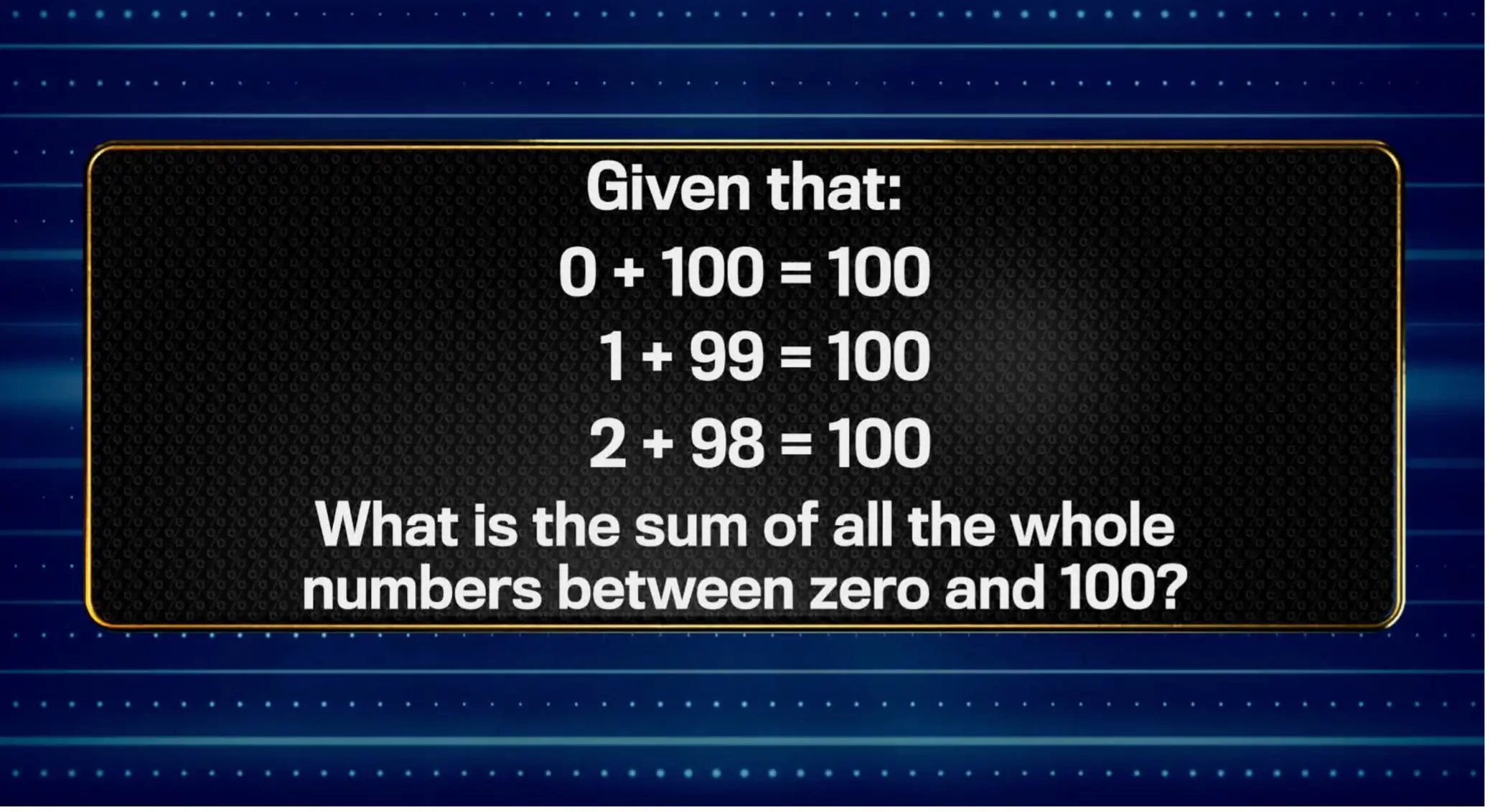
The final challenge on The 1% Club looked like a straightforward maths problem, but with £100,000 potentially at stake and just 30 seconds on the clock, even the two remaining contestants decided not to take the risk.
Maisie and Alex had made it through the earlier rounds of ITV’s popular quiz show, hosted by comedian Lee Mack. Yet when they reached the final question, they faced a difficult choice: gamble their winnings on a deceptively simple puzzle or walk away with £5,000 each.
Ultimately, they chose the safer option. But when the answer was revealed, it became clear why the question had caused so much confusion — and why viewers watching at home were admitting they had struggled with it too.
The question that caused all the confusion
The 1% Club is known for testing logic, reasoning and common sense rather than relying on general knowledge. As contestants progress through the competition, the questions become increasingly challenging, with the final stages offering the chance to compete for a prize of up to £100,000.
In the episode described, Maisie and Alex were the last two contestants standing. Their final challenge gave them only 30 seconds to solve the following problem:
“Given that: 0 + 100 = 100, 1 + 99 = 100, 2 + 98 = 100, what is the sum of all the whole numbers between zero and 100?”
At first glance, the examples seemed to point towards a simple pattern. Each pair of numbers added up to 100, making 5,000 appear to be a reasonable answer.
That was also the figure Maisie and Alex suggested to Lee Mack. However, they had overlooked one important detail — a number that did not fit into any of the pairs.
With their winnings on the line, the contestants decided against gambling and secured £5,000 each instead.
Viewers admitted they were stumped too
Maisie and Alex were far from alone in finding the problem difficult. Viewers quickly took to social media to share their confusion, with some admitting that they had been unable to work out the answer within the time limit.
One viewer asked: “Help me understand???”
Another described it as “possibly the hardest 1% question I’ve come across,” suggesting it could even have been a “0.1% question.”
Others admitted that the number-based questions regularly caught them out. One wrote: “The number ones always get me!”
Another simply confessed: “I didn’t get it. Gutted.”
For some viewers, the pressure of mental arithmetic made the challenge even more intimidating. One person explained that they had not even attempted it, saying maths was difficult enough with a calculator, let alone when they had only 30 seconds to think.
The reaction showed how a question built around a familiar numerical pattern could become surprisingly difficult when contestants had to identify the complete sequence under pressure.
So, what was the correct answer?
Lee Mack revealed that Maisie and Alex had been close. Their suggested answer of 5,000 came from correctly recognising that the numbers could be arranged into pairs that each totalled 100.
The sequence begins with 0 and 100, followed by 1 and 99, then 2 and 98. Continuing in this way creates 50 pairs, each adding up to 100.
Multiplying those 50 pairs by 100 gives a total of 5,000.
But there is one number left over: 50.
Unlike the other numbers, 50 sits directly in the middle of the sequence. It pairs with itself rather than forming a separate pair of two different numbers, so it must be added to the total.
That gives the calculation:
50 × 100 = 5,000
5,000 + 50 = 5,050
The correct answer was therefore 5,050, not 5,000.
A small detail made all the difference
The puzzle demonstrates how easily a seemingly obvious pattern can lead to an incomplete answer. Maisie and Alex had identified the pairs correctly, but their calculation missed the middle number — the small detail that changed the final result.
With only 30 seconds to work, it was an easy mistake to make. And judging by the reactions from viewers at home, plenty of people would have found themselves in the same position.
For The 1% Club, that is precisely what makes these questions so challenging: the answer may look simple once it is explained, but spotting the crucial detail before the clock runs out is another matter entirely.