King Charles And Queen Camilla Caught In Caribbean Downpour As Antigua’s Prime Minister Escalates Demand For Slavery Reparations And Calls For Monarchy To End

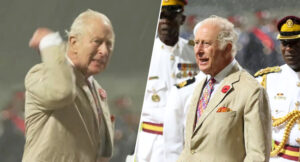
King Charles was left standing helplessly in torrential rain in Antigua after an apparent umbrella mix-up turned an official royal appearance into an awkward spectacle. As Queen Camilla was quickly handed protection, the drenched monarch was forced to gesture frantically towards aides, waiting for someone to bring him cover.
The King eventually found humour in the uncomfortable moment, joking that he had started growing watercress on his trousers. But behind the light-hearted scenes, the royal visit was unfolding against a far more serious backdrop: mounting pressure on Britain to pay reparations for its historic role in the transatlantic slave trade, and renewed calls for Antigua and Barbuda to remove Charles as its head of state.
The timing could hardly have been more sensitive.

Charles Left Soaked As Camilla Receives An Umbrella First
The incident happened shortly after the King and Queen arrived at Sir Vivian Richards Cricket Stadium for celebrations marking the 45th anniversary of Antigua and Barbuda’s independence.
As the heavens opened, Charles suddenly found himself exposed to the tropical downpour, with no umbrella in sight. He threw his arms into the air, waved frantically and appeared to tell an aide to ‘bring it’.
Meanwhile, Camilla was quickly given a clear dome umbrella and escorted towards the royal seating area, leaving her husband standing in the rain.

The King eventually received an umbrella, but by then the damage was done. His beige summer suit was drenched, rain was running down his face and he occasionally had to wipe himself with a handkerchief.
Camilla also appeared to gesture for some kind of cover as the rain continued to fall.
Rather than allowing the mishap to derail the occasion, Charles took it in good humour. Reflecting on his soaking afterwards, he quipped: ‘I’ve started growing watercress on my trousers.’
The downpour lasted around five minutes before clearing, allowing the independence celebrations to continue.

Prime Minister Wants Antigua To Become A Republic
While the royal couple were dealing with the weather, another storm was gathering over their place in the Caribbean nation.
Antigua and Barbuda’s Prime Minister, Gaston Browne, has openly declared that he would personally like to see King Charles removed as the country’s head of state.
Speaking to ITV News after attending a Sunday morning church service alongside the King and Queen, Browne made clear that he favours replacing the monarchy with a republic.
‘I can say to you, I am a Republican. So if you asked me about my personal view, I would like to see Antigua and Barbuda become a republic,’ he said.
However, he acknowledged that changing the country’s constitutional arrangements would require a democratic decision.

Under the current constitution, more than two-thirds of Antiguans must vote in favour of replacing the British monarch and changing the constitution.
Browne insisted that he respected Charles personally and recognised his position under the existing system.
‘So until such time as the question is put to them, I have to accept that, you know, King Charles remains. I serve the King, and he will continue to benefit from, you know, all of the courtesies and respect as our King,’ he said.
But he added that the issue would continue to be tested.
His comments came just days after he renewed his demands for Britain to address the legacy of slavery through financial reparations.

Slavery Reparations Row Puts Britain Under Fresh Pressure
Browne argued that Britain’s difficulty in agreeing to compensation should not be treated as a reason to dismiss the issue.
‘I understand the politics in the UK, in which it may be a difficult proposition for him to agree to any form of reparations, but that does not negate the need for reparations,’ he told ITV.
He also rejected the suggestion that Caribbean countries were making unreasonable financial demands.
According to Browne, the money could be found through Britain’s overseas development budget rather than placing an entirely new burden on the public.
He warned that refusing compensation could have consequences beyond the immediate dispute, arguing that financial liability would serve as a deterrent against similar atrocities in the future.

‘If there is no compensation, there’s likely to be a repeat of those atrocities sometime in the future. And you can see what is happening globally already,’ he said.
When asked whether he was referring to Russia’s invasion of Ukraine, Browne did not give a direct confirmation.
Instead, he pointed to what he described as an increasingly brutal international climate.
‘I’m saying here that countries are becoming far more brutal. And if there’s not some form of compensation and even liability for future generations, the present generation must understand that the actions could also affect future generations,’ he told ITV News.

Britain Opens Door To An Apology But Rules Out Compensation
The dispute comes as Andy Burnham’s government has signalled its willingness to discuss a formal British apology for slavery, while firmly rejecting financial reparations.
On Friday, Mr Burnham expressed ‘my sorrow and regret for the pain and suffering of so many millions’.
His offer to discuss an apology marked a significant development, with no previous British prime minister having made such an apology.
However, he made clear that the British public should not be expected to pay compensation for historical events.

That position leaves a significant gap between Britain’s approach and the demands being made by Caribbean leaders.
Browne has maintained that an apology alone would not address the financial consequences of slavery or provide the compensation he believes is necessary.
The debate was expected to feature prominently at the Commonwealth Heads of Government Meeting (CHOGM) in Antigua this week, despite the official theme being ‘Accelerating Partnerships and Investment for a Prosperous Commonwealth’.
The meeting takes place every two years and brings together leaders from across the Commonwealth.

King Continues Independence Celebrations Despite The Downpour
Despite the awkward start, Charles carried on with his scheduled engagements.
After the rain eased, he stood on a small dais as dozens of troops assembled on the former cricket pitch, which had been transformed into a parade ground.
Sheltering beneath an umbrella, the King inspected the service personnel before returning to cheers from the assembled crowds. He acknowledged the welcome with a wave alongside Camilla.
The annual Independence Ceremonial Parade remains the centrepiece of Antigua and Barbuda’s celebrations.
Later, Governor-General Sir Rodney Williams presented the National Honourees to Their Majesties. The recipients were recognised for distinguished contributions to the country and its people across public life, culture, sport, education and community service.
Charles and Camilla also watched the closing ceremonial sequence before greeting students and four celebrated West Indies cricketing figures: Sir Vivian Richards, Sir Richie Richardson, Sir Andy Roberts and Sir Curtly Ambrose.

Sir Vivian Richards Welcomes Royal Couple To His Home Turf
Cricket legend Sir Vivian Richards was among the prominent figures involved in the royal visit.
On Sunday night, he had been announced as a Sustainable Markets Initiative Ambassador, representing the movement founded by Charles to encourage more environmentally friendly practices across industry and business.
Richards described the King’s visit as a significant moment for the region.
‘It’s just an exciting time for us as people. It couldn’t be any better having the King and the Queen here. It means a lot to us. It’s a win-win situation,’ he said.
He also reflected on meeting Charles previously at Buckingham Palace, joking that welcoming the monarch to his home turf in Antigua helped even things out.

Richards described it as an ‘immense privilege’ to represent the King in Antigua and throughout the Commonwealth.
The West Indies World Cup winner was invited to meet Charles and Camilla at the National Stadium bearing his name ahead of CHOGM.
The King greeted him warmly, saying it was ‘so good to see you again’.
Richards, widely regarded as one of the most talented batsmen of his era, won the Cricket World Cup in 1975 and 1979 and captained the West Indies from the mid-1980s until 1991.
He appeared alongside fellow cricketing legends Sir Curtly Ambrose, Sir Andy Roberts and Sir Richie Richardson for a private meeting with the royal couple, followed by the independence parade.

Charles Takes Part In Commonwealth Cricket Celebrations
The King’s sporting engagements continued when he was invited to toss a commemorative coin to determine which team would bat first in an exhibition cricket match.
The fixture, known as the Heads of Government T5 exhibition match, featured Caribbean leaders playing for the Caribbean Commonwealth Cricket Team against heads of government representing the Wider Commonwealth Cricket Team.
A second match followed, featuring Commonwealth Future Stars Under-23 and highlighting emerging cricketing talent from across the Commonwealth.
Although the sporting celebrations offered a lighter moment during the royal tour, the wider political discussions surrounding the meeting were expected to be considerably more challenging.

With Antigua and Barbuda’s Prime Minister openly supporting republican status and insisting that Britain must address slavery through reparations, Charles’s visit has brought an uncomfortable debate back into the spotlight.
For the King, the five-minute tropical downpour was only a brief interruption to an otherwise packed programme. The questions surrounding Britain’s historical responsibility, the future of the monarchy in the Caribbean and the demands for compensation are unlikely to disappear when the rain stops.