This Deceptively Simple Number Puzzle Could Leave You Staring At The Screen — Can You Work Out What Comes Next?
At first glance, it looks like one of the easiest number puzzles imaginable. There are no complicated calculations, no lengthy instructions and no unfamiliar symbols. Just four digits, an equals sign and a series of answers that seem to follow a mysterious pattern.
But look a little closer, and the challenge becomes considerably more intriguing.
The puzzle asks one deceptively straightforward question: “What number replaces the question mark below?”
The four lines display the same number, 1471, followed by three different results and one missing answer:
- 1471 = 7
- 1471 = 8
- 1471 = 10
- 1471 = ?
There is no obvious mathematical operation to guide you. The number on the left never changes, yet the results on the right keep increasing. That unusual detail is precisely what makes the puzzle so fascinating.
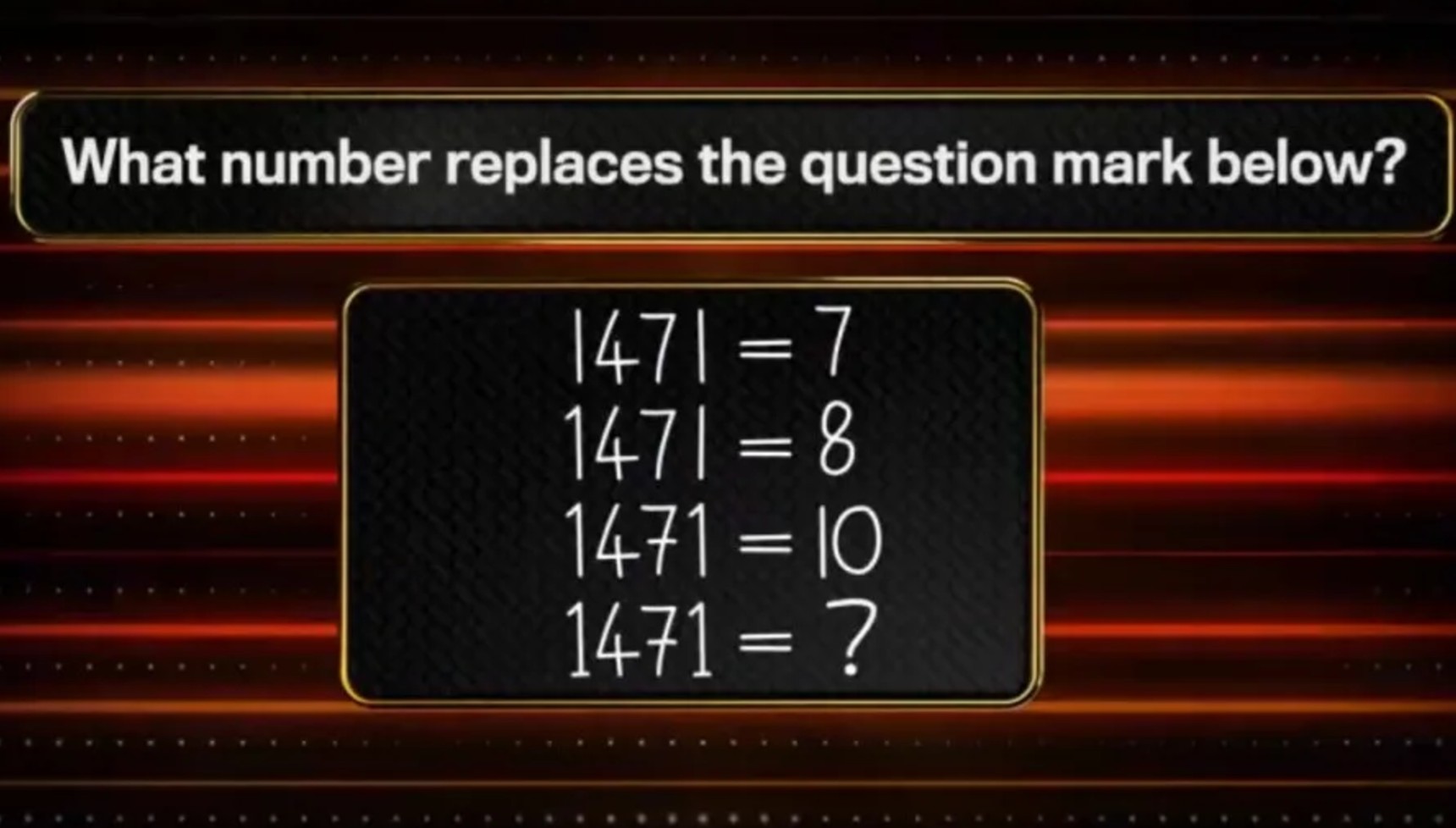
The hidden pattern is the real challenge
Most people instinctively approach a number puzzle by looking for familiar mathematical relationships. They might try adding the digits together, multiplying them or searching for a connection between the individual numbers.
However, this challenge offers no indication that ordinary arithmetic is the way to find the solution.
The repeated appearance of 1471 is particularly important. If the same number produces three different answers, something other than its numerical value may be influencing the result.
That is where the real brainwork begins.
Rather than immediately reaching for a calculator, anyone attempting the puzzle needs to examine the way the number is presented. Could the arrangement of its digits hold a clue? Is there a less obvious feature that connects the three results? Or is the answer hidden in something that most people would normally overlook?
The image provides no additional explanation, leaving the solver to investigate the pattern independently.
Can you find the missing number?
The challenge may look simple enough to solve in a matter of seconds, but its unusual format encourages people to question their first instincts.
One possible mistake is to assume that the answer must come from a conventional calculation. Another is to focus so heavily on the numbers themselves that a different kind of pattern goes unnoticed.
The key is to consider all the information available rather than settling on the first explanation that seems plausible.
Take another look at the sequence:
1471 = 7
1471 = 8
1471 = 10
1471 = ?
What changes between the three completed lines? More importantly, what rule could explain all three results while also producing the missing number?
There is only one question mark to replace, but finding the logic behind it is the real test.
Don’t give up too quickly!
The most satisfying brainteasers are often those that make people rethink something they initially considered obvious. This puzzle does exactly that by presenting a familiar-looking number in an unfamiliar way.
Before looking for hints or asking someone else for the solution, give yourself a little time to work through the possibilities. Pay attention to the details, challenge your assumptions and see whether you can identify a consistent rule.
So, what number do you think belongs after the final equals sign?
Can you crack the pattern without any help, or will this seemingly simple puzzle leave you scratching your head?
Take your time, trust your observation skills and see if you can uncover the missing answer!