Steven Spielberg’s Overlooked Western Epic That Helped Shape Modern Frontier Television
Long before Taylor Sheridan brought the American West back into the television spotlight with Yellowstone, 1883 and 1923, Steven Spielberg helped deliver an ambitious Western saga that explored the frontier from two sharply contrasting perspectives. Premiering on TNT in 2005, Into the West unfolded across six feature-length episodes, tracing nearly seven decades of American history through the intertwined lives of a white settler family and a Lakota family.
Backed by DreamWorks Television and executive-produced by Spielberg, the 12-hour miniseries combined the scale of a historical epic with an unflinching look at the human cost of westward expansion. Though it has become less familiar to many modern viewers, its ambitious storytelling and expansive ensemble make it a notable predecessor to today’s character-driven Western dramas.
Two Families, One Changing American Frontier
Rather than telling the story of westward expansion solely through the eyes of settlers, Into the West follows two families whose lives become increasingly connected as the United States pushes further across the continent.
One storyline centres on the Wheelers, a white family whose journey begins in Virginia. Driven by the prospect of adventure, opportunity and a better life, they travel west through a rapidly changing landscape shaped by migration, settlement and economic ambition.
The other follows a Lakota family struggling to preserve its culture, traditions and homeland as the arrival of settlers brings mounting pressure and upheaval. At the heart of this story are Lakota holy man Loved By the Buffalo, played by Joseph M. Marshall III, and his family.
The two narratives gradually converge through Jacob Wheeler (Matthew Settle), whose relationship with Thunder Heart Woman (Tonantzin Carmelo), the sister of Loved By the Buffalo, brings the families together. Their connection creates a personal link between two communities whose hopes for the future are increasingly at odds.
Spanning the years from 1825 to 1890, the series places these family stories against major turning points in American history. The California Gold Rush, the Civil War, the Pony Express, the construction of the Transcontinental Railroad and the Indian Wars all form part of the wider historical backdrop.
As the decades pass, the characters experience the opportunities, conflicts and devastating consequences of a nation being transformed.
A Western That Tries to Tell Both Sides of the Story

One of the series’ defining ambitions was its effort to give Native American characters a more substantial place in the narrative than they traditionally received in Hollywood Westerns.
The Lakota family is not simply part of the scenery surrounding the settlers’ journey. Its members have their own relationships, beliefs, ambitions and struggles, while the story explores how westward expansion threatens their way of life.
The production also made a deliberate effort to incorporate Indigenous languages. Lakota and other Native languages were used in the dialogue, with English subtitles allowing audiences to follow the conversations. Native American language coaches and historical advisers helped the actors prepare, while period clothing and cultural details were developed with attention to authenticity.
This approach was an important part of the production’s identity. However, the series’ attempt to present a more balanced account of the frontier was not universally accepted. Some Native American commentators criticised aspects of its historical representation and argued that certain stereotypes remained. The debate reflected the difficulty of portraying such a complex history, even in a production making a clear effort to broaden the perspective.
A Remarkable Cast of Hollywood and Indigenous Talent
With approximately 250 speaking parts, Into the West assembled an unusually large ensemble, bringing together established Hollywood performers and prominent Native American actors.
The Wheeler family and other settlers are portrayed by a cast that includes Josh Brolin, Keri Russell, Matthew Settle, Skeet Ulrich, Sean Astin, Beau Bridges, Gary Busey and Tom Berenger.
The Native American ensemble is equally significant, featuring Wes Studi, Russell Means, Graham Greene, Gil Birmingham, Zahn McClarnon, Tatanka Means, Irene Bedard, Eric Schweig and Michael Spears.
Other familiar faces include Keith Carradine, Christian Kane, Craig Sheffer and Matthew Modine.
Several performers would go on to become especially recognisable to audiences of contemporary Western television. Gil Birmingham later became widely known for playing Chairman Thomas Rainwater in Yellowstone, while Zahn McClarnon continued to build a prominent career across Western and crime dramas.
Their involvement gives the miniseries an additional point of interest for viewers who have followed the evolution of modern frontier storytelling.
The Historical Events Behind the Six-Part Saga
Across its six episodes, Into the West moves through some of the most consequential chapters of 19th-century American history.
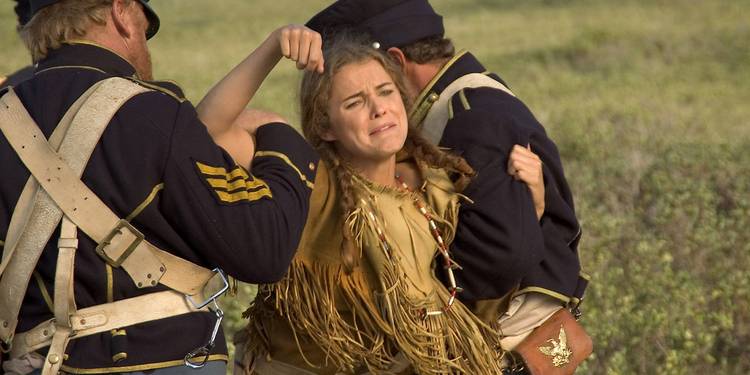
The California Gold Rush and the expansion of the railroad reflect the promise of wealth and opportunity that drew settlers west. But the series also examines the violence and dispossession accompanying that expansion, including military conflict, broken agreements and the destruction of Native American communities.
Among the darker events explored are the Sand Creek Massacre and the growing pressures that forced Indigenous families from their ancestral lands. The later chapters turn towards the Ghost Dance movement and the tragedy at Wounded Knee, bringing the story to a devastating historical conclusion.
The miniseries also addresses the destruction of the buffalo herds and the impact of boarding schools designed to suppress Indigenous cultures. These events reveal the enormous human cost behind the expansion often celebrated in traditional frontier stories.
By placing these developments within the lives of its characters, the series connects sweeping historical change with the experiences of ordinary people caught up in it.
Spielberg’s Ambitious Television Production Earned Two Emmys
Produced by DreamWorks Television for TNT, Into the West was a major undertaking for its time. The series featured six feature-length instalments and brought together six directors to tell a story stretching across generations.
Its scale was reflected in its awards recognition. At the 2006 Primetime Emmy Awards, the miniseries received 16 nominations and won two, including awards for sound mixing and original dramatic music.
The production also received recognition from the Western Heritage Awards, further cementing its place among notable television Westerns of its era.
Spielberg served as executive producer rather than director, but his involvement was significant. The project was designed as a sweeping historical television event, combining large-scale production with an emphasis on telling the story of the American West from more than one perspective.
Why Modern Western Fans Should Revisit It
For viewers who appreciate the expansive family histories and harsh frontier landscapes of 1883 and 1923, Into the West offers an earlier television interpretation of similar themes.
The series explores ambition, migration, cultural conflict and the struggle to survive in a rapidly changing world. But its most distinctive feature is the way it places the experiences of settlers alongside those of the Indigenous people whose lives were transformed — and often devastated — by their arrival.
It is not a flawless account of American history, and its portrayal of Native communities drew criticism even at the time. Nevertheless, its scale, extensive cast and willingness to confront the darker consequences of westward expansion make it a significant entry in the history of television Westerns.
Long before the modern Western boom, Spielberg and DreamWorks brought this six-part saga to the screen. For anyone interested in the stories and historical conflicts that continue to shape the genre, it remains a compelling piece of television history.