A deceptively simple maths puzzle on ITV’s The 1% Club proved so difficult that even the two contestants who reached the final chose not to attempt it. Hosted by Lee Mack, the quiz show challenges players to solve increasingly tricky questions, but this particular brain teaser left viewers struggling to find the answer.
The puzzle was difficult enough for some fans to suggest that it belonged in a category even harder than the show’s notoriously challenging 1% questions.

How The 1% Club Works
The ITV quiz show, presented by comedian Lee Mack, begins with 100 contestants answering a series of questions that become progressively more difficult. Anyone who gets an answer wrong is eliminated, adding £1,000 to the prize pot each time.
Those who survive until the end face a final challenge designed to be solvable by only 1% of the population. Contestants can attempt the question for a chance to win the accumulated prize money or choose to walk away with their share of the £10,000 prize pot.
A key part of the show’s appeal is the way its questions test logic and lateral thinking rather than relying solely on general knowledge. What initially looks like a confusing sequence of letters or numbers can become much easier once contestants recognise the pattern hidden behind it.
However, one particularly challenging final question proved to be a different story.

Viewers Struggle With the Final Brain Teaser
The puzzle left several viewers baffled, with one fan describing it as “possibly the hardest 1% question I’ve come across” and suggesting it could even qualify as a “0.1% question”.
Others admitted that number-based questions were their biggest weakness. Some viewers were so confused by the challenge that they did not even attempt to work out the answer.
As Lee Mack moved between presenting the questions and joking with the audience, the tension surrounding the final puzzle became part of the entertainment.
Think you can solve it? Before reading any further, give yourself 30 seconds to work out the answer.
Can You Solve the 30-Second Question?
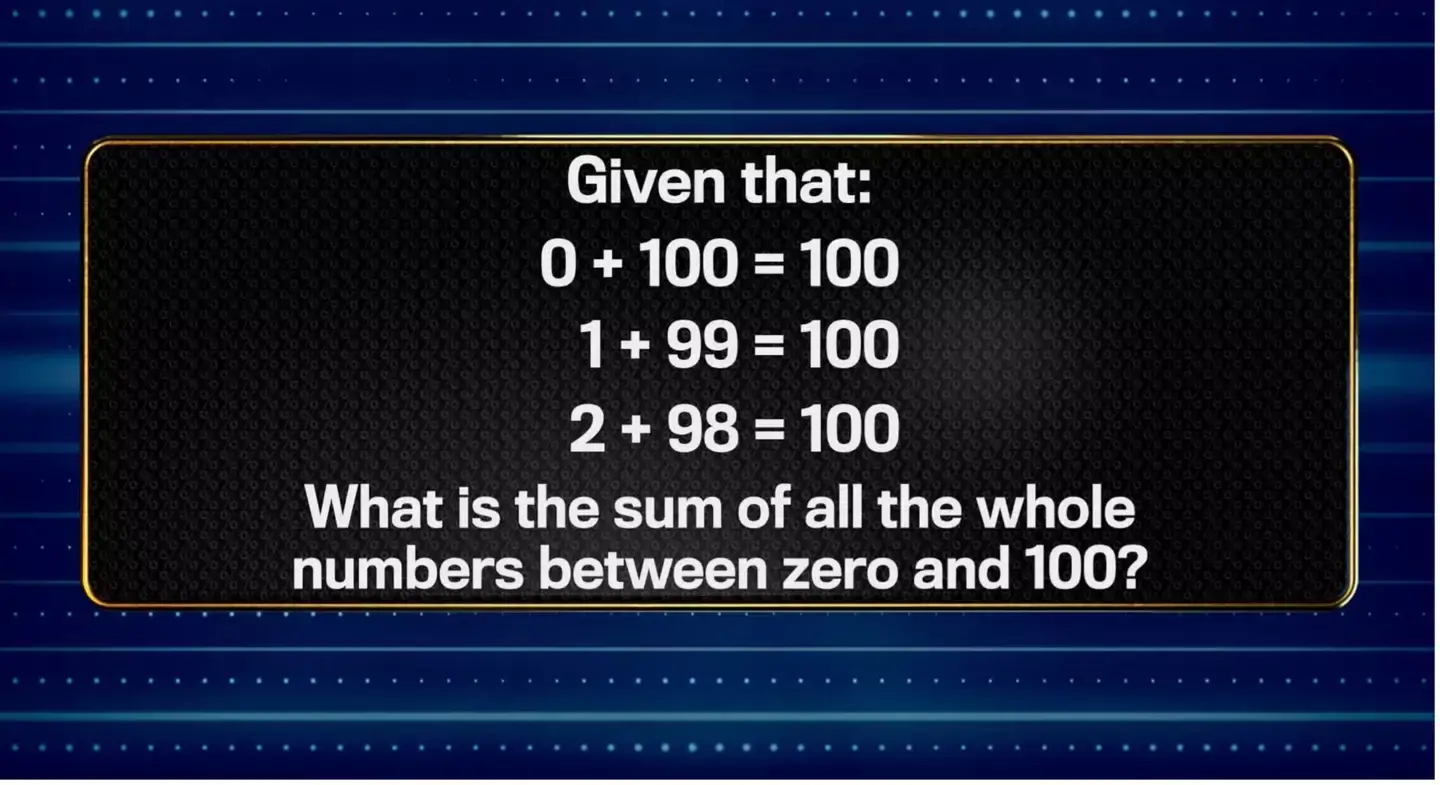
The question presented to the contestants was:
“Given that: 0+100 = 100, 1+99 = 100, 2+98 = 100, what is the sum of all the whole numbers between zero and 100?”
At first glance, the pattern seems straightforward. Each pair of numbers adds up to 100, suggesting that finding the total should be relatively easy.
But there is one important detail that makes the difference between a nearly correct answer and the right one.
Why the Contestants Decided to Walk Away
The two finalists, Maisie and Alex, opted not to risk their winnings on the final question. Instead, they each took home £5,000, securing an equal share of the prize pot rather than gambling everything on a puzzle they could not confidently solve.
Their decision appeared sensible when Lee Mack subsequently asked whether they could hazard a guess at the answer.
Neither contestant managed to give the correct total, although their response came remarkably close. They suggested 5,000, overlooking one crucial part of the calculation.
The Correct Answer Is 5,050
The trick is to recognise how the numbers can be paired.
Starting at zero, each number can be matched with another number that brings the total to 100:
- 0 + 100 = 100
- 1 + 99 = 100
- 2 + 98 = 100
The same pattern continues throughout the sequence. There are 50 pairs that each add up to 100, giving a combined total of 5,000.
However, the calculation is not quite finished. The number 50 sits in the middle of the sequence and does not have a separate partner to form another pair. It must therefore be added to the total.
That gives us:
50 × 100 + 50 = 5,050
So, the sum of all the whole numbers from zero to 100, inclusive, is 5,050.
The difference between 5,000 and 5,050 comes down to a single overlooked number. It is a neat example of how The 1% Club turns an apparently simple question into a test of careful reasoning, rewarding contestants who spot every detail rather than rushing towards an obvious-looking answer.